Why the "Multiply by 7" Rule Is Wrong
The popular belief that one dog year equals seven human years is a vast oversimplification that does not reflect how dogs actually age. This rough approximation may have originated from dividing the average human lifespan (70 years) by the average dog lifespan (10 years). But dog aging is not linear — dogs age much faster in their early years and much more slowly in middle age. A one-year-old dog is not equivalent to a 7-year-old child. A one-year-old dog is sexually mature, physically developed, and equivalent to a young adult human — closer to 15 to 20 in human terms.
The Science of Dog Aging
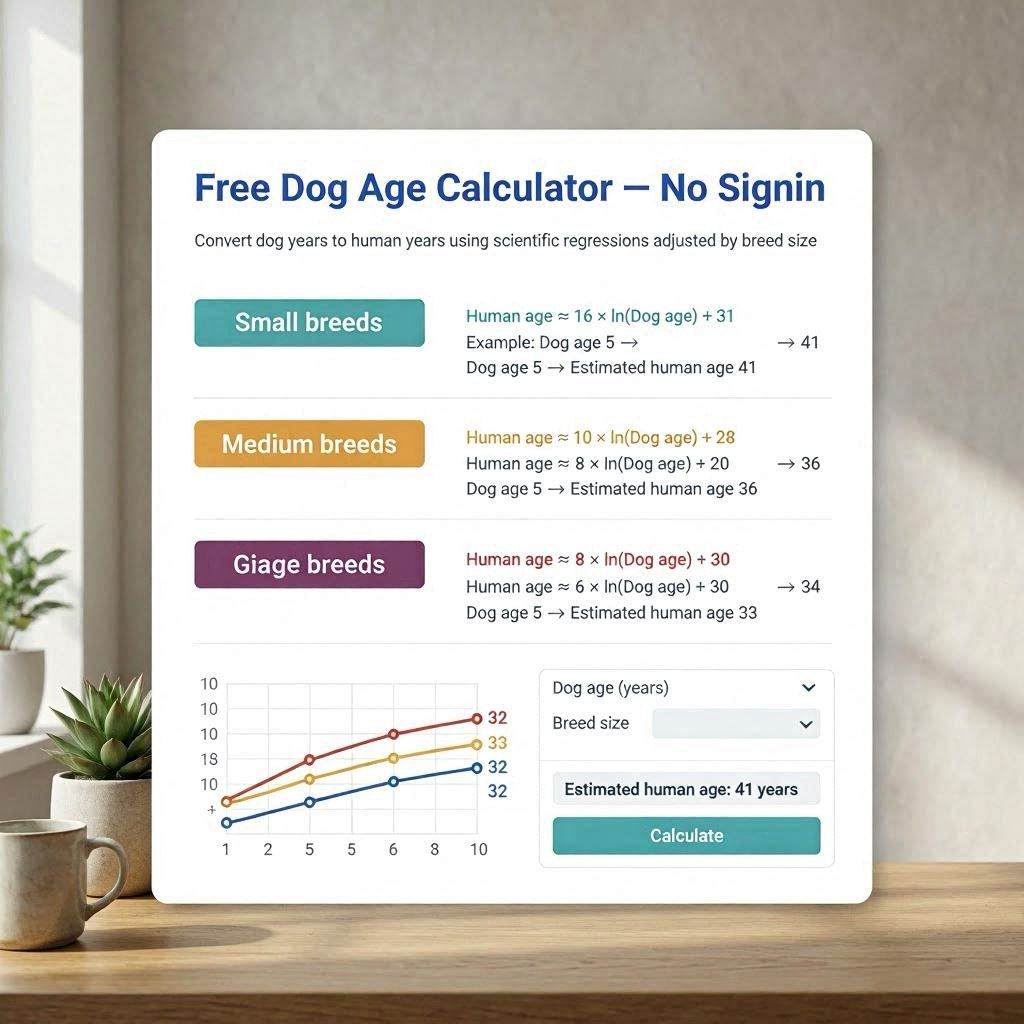
A 2019 study published in the journal Cell Systems by researchers at the University of California San Diego proposed a more scientifically grounded formula based on DNA methylation patterns — chemical changes to DNA that accumulate with age in both humans and dogs. The study found that dogs and humans share similar methylation patterns early in life but diverge significantly as dogs enter middle age. The research suggests a logarithmic relationship: human age = 16 × ln(dog age) + 31. This formula produces more accurate equivalencies across a dog's lifespan than the simple multiplication method.
How Breed Size Affects Aging
One of the most significant factors in dog aging is body size. Large and giant breed dogs age faster than small breeds and have significantly shorter lifespans. A Great Dane has an average lifespan of 7 to 10 years, while a Chihuahua may live 15 to 20 years. The reasons for this size-lifespan relationship are not fully understood but are thought to involve the faster growth rates and higher metabolic demands of larger dogs, which appear to accelerate aging processes. A 7-year-old large breed dog is already in its senior years, while a 7-year-old small breed dog is still in middle age.
Dog Life Stage Categories
The American Veterinary Medical Association (AVMA) categorizes dogs into life stages rather than relying on exact age equivalencies. Puppies are dogs in their first year of life — a period of rapid growth and development. Juniors are young adult dogs that have reached physical maturity but are not yet fully mature. Adults are fully mature dogs in the prime of life. Mature dogs are in the second half of their expected lifespan. Seniors are dogs in the last quarter of their expected lifespan. Geriatric dogs have exceeded the average lifespan for their size. Knowing your dog's life stage helps you provide appropriate nutrition, veterinary care, and exercise.
Health Care by Life Stage
Understanding your dog's equivalent human age helps you anticipate health care needs. Puppies require vaccination series, socialization, and training. Young adults benefit from dental care, parasite prevention, and maintaining healthy weight. Middle-aged dogs should begin more frequent veterinary checkups to catch age-related conditions early. Senior and geriatric dogs benefit from twice-yearly veterinary visits, joint health monitoring, cognitive support, and dietary adjustments for lower activity levels.
How to Use Our Free Dog Age Calculator
Our free dog age calculator at cookiescursor.com converts your dog's age to a human equivalent using size-adjusted formulas. Select your dog's size category (Small under 20lbs, Medium 20-50lbs, Large 50-90lbs, Giant over 90lbs), enter their age in years and months, and get their human age equivalent, life stage classification, average life expectancy for their size, and relevant life stage information. No signup required.
Frequently Asked Questions
How old is a 10-year-old medium dog in human years?
A 10-year-old medium-sized dog is approximately 60 to 65 in human years — firmly in senior territory and due for more frequent veterinary checkups.
Why do small dogs live longer than large dogs?
The exact mechanism is not fully understood, but larger dogs appear to age at a cellular level more rapidly, possibly due to higher growth hormone levels and faster growth rates that accelerate biological aging processes.
At what age is a dog considered a senior?
This varies by size. Small breeds are generally considered senior at around 10 to 12 years. Medium breeds at 8 to 10 years. Large breeds at 7 to 8 years. Giant breeds at 5 to 6 years.
Can dogs develop age-related diseases like humans?
Yes. Dogs develop many of the same age-related conditions as humans — arthritis, cancer, cognitive dysfunction (similar to dementia), kidney disease, and heart disease all become more common in senior dogs.
How can I help my dog age healthily?
Regular veterinary care, appropriate nutrition for their life stage, dental hygiene, maintaining healthy weight, regular exercise appropriate for their age, and mental stimulation all contribute to healthy aging in dogs.
Is the 7-year rule ever approximately correct?
For middle-aged dogs of average size, the 7x rule happens to produce a rough approximation. But it significantly underestimates the aging in the first 2 years and overestimates aging in the senior years.
Calculate Your Dog's Age Now
Use our free dog age calculator to find your dog's human age equivalent by breed size. No signup required.