
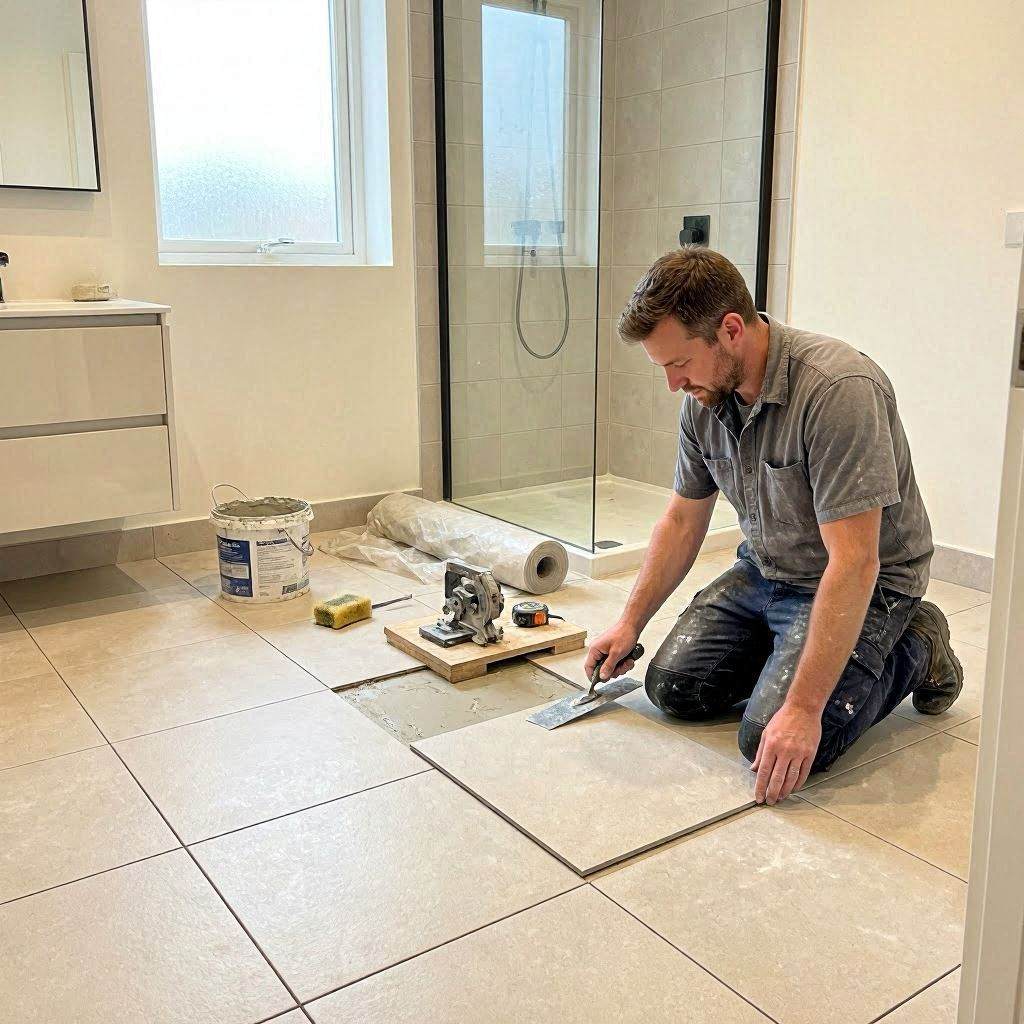
Why You Always Need Extra Tiles
Every tiling project generates waste from cuts. Tiles at the edges of a room must be cut to fit. Tiles in corners, around fixtures, and along walls all require cutting that produces off-cuts. Some tiles crack during cutting. Some are damaged during installation. The waste factor — extra tiles to account for these losses — is not optional: it is a necessary part of accurate material calculation.
The Basic Tile Calculation
The base calculation is simple: divide the total area by the area of one tile to get the number of tiles needed. For a 120 square foot room using 12×12 inch tiles (1 square foot each), you need a minimum of 120 tiles. For 18×18 inch tiles (2.25 square feet each), you need approximately 54 tiles. For smaller tiles like 4×4 inch (0.111 square feet each), you need approximately 1,080 tiles. Our calculator handles any tile size in both Imperial and Metric units.
Waste Factor by Installation Pattern
The standard waste factor is 10% for straight lay installation — tiles laid in a grid pattern parallel to the walls. Diagonal installation (tiles laid at 45 degrees) generates significantly more waste because every edge tile requires a cut — add 15% for diagonal patterns. Complex patterns like herringbone, basketweave, or mixed size patterns typically require 15% to 20% additional material. For first-time DIY installers, add an extra 5% to account for learning curve breakage.
Tile Sizes and Their Applications
Small tiles (under 6×6 inches) are traditional for bathroom floors and kitchen backsplashes. Medium tiles (6×6 to 12×12 inches) are the most versatile and are used in bathrooms, kitchens, and entryways. Large format tiles (18×18 and above) create a seamless look with fewer grout lines and are increasingly popular for open plan living spaces. Very large tiles (24×24 and above) require perfectly level subfloors — any variation causes lippage (uneven tile edges) that is both unsightly and a tripping hazard.
How to Use Our Free Tile Calculator
Our free tile calculator at cookiescursor.com calculates the number of tiles needed for any room. Enter the room area or dimensions, select your tile size (common sizes pre-loaded or enter custom dimensions), choose your installation pattern, and set the waste factor. Results show tiles needed, tiles with waste factor applied, and boxes needed if you enter tiles per box. No signup required.
Frequently Asked Questions
How many extra tiles should I buy?
Always buy 10% more than calculated for straight lay, 15% more for diagonal. Keep leftover tiles for future repairs — matching discontinued tiles years later is difficult and expensive.
What is lippage in tiling?
Lippage is the height difference between adjacent tiles. Modern large format tiles require a subfloor flatness of within 1/8 inch over 10 feet to avoid visible lippage.
How do I calculate grout quantity?
Grout quantity depends on tile size, joint width, and tile thickness. Our calculator includes a grout estimate based on joint width and tile dimensions.
Can I tile over existing tiles?
Yes, if the existing tiles are firmly bonded and the added height does not create problems with doors, fixtures, or transitions. Check that the subfloor can handle the additional weight.
What is the minimum tile size for a shower floor?
Shower floors require a slope to the drain. Smaller tiles (2×2 or mosaic tiles on mesh) conform better to the curved slope than large format tiles.
How long does tile installation take to dry?
Tile adhesive requires 24 hours before grouting. Grout requires 24-72 hours before use. Allow 7 days before heavy use or cleaning.
Calculate Your Tiles Now
Use our free tile calculator to get exact tile quantities for any project. No signup required.