
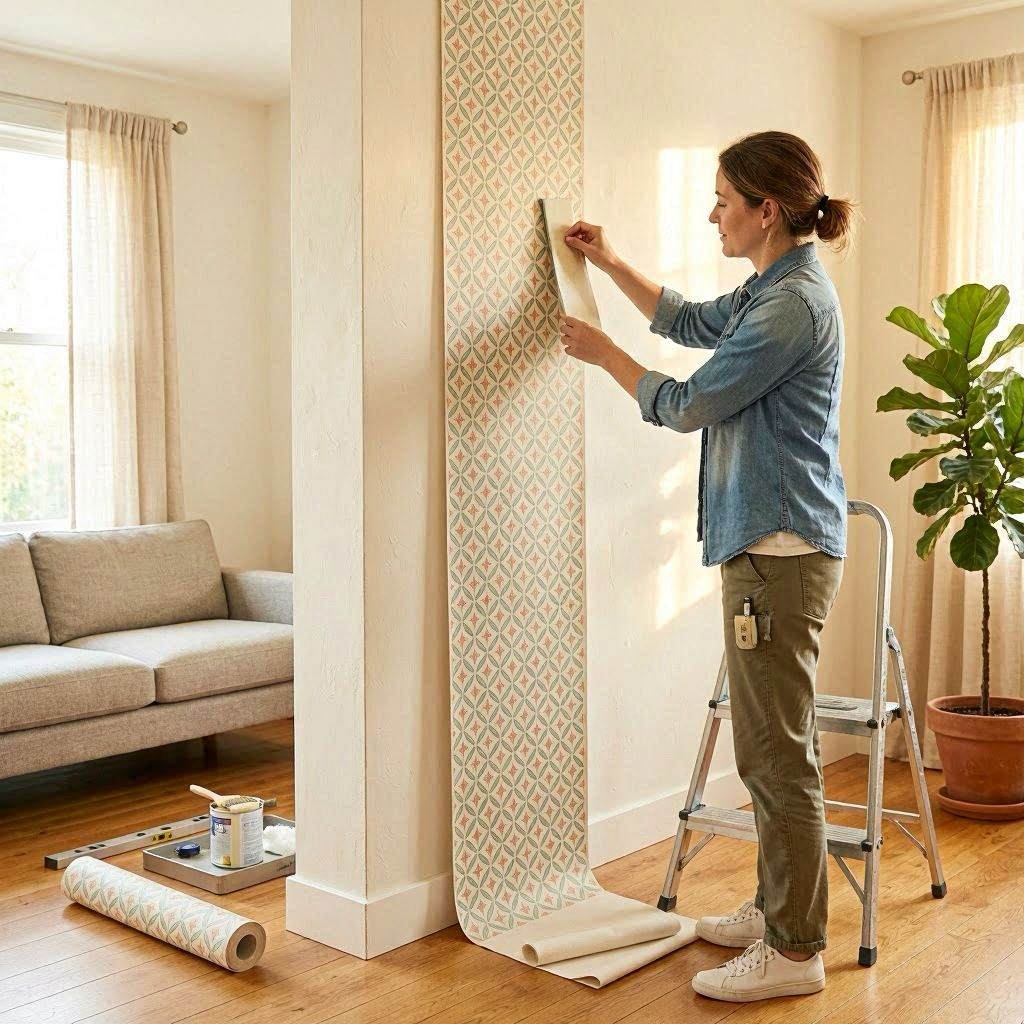
Why Wallpaper Calculation Is Tricky
Unlike paint, where you can buy an extra quart and return the unopened can, wallpaper dye lots vary between production runs. If you run short and order more rolls later, the new rolls may have a slightly different color — visible to anyone who knows where to look. Getting the quantity right before you start is critical. Most professional decorators add 10% to 15% extra as a buffer and keep spare rolls for future touch-ups.
The Basic Wallpaper Formula
The starting point is total wall area: perimeter of the room multiplied by wall height. For a room that is 12 feet by 15 feet with 8-foot ceilings, the perimeter is (12 + 15 + 12 + 15) = 54 feet. Total wall area is 54 × 8 = 432 square feet. From this, subtract the area of doors and windows — typically 21 square feet per standard door and 15 square feet per standard window. Each roll of wallpaper covers a specific area printed on the packaging — typically 28 to 56 square feet for US standard rolls and 56 to 72 square feet for European double rolls.
Understanding Pattern Repeat
Wallpaper with a pattern repeat requires extra material to ensure the pattern aligns correctly between strips. A pattern repeat of 12 inches means every strip must start at the same point in the pattern — which requires cutting and wasting material at the top of each strip to achieve alignment. The larger the pattern repeat, the more waste is generated. For patterns with repeats under 6 inches, add 10% waste. For repeats of 6 to 18 inches, add 15%. For large repeats over 18 inches, add 20% or more.
Ceiling Height Matters
Standard 8-foot ceilings are the most common in US homes and are what most wallpaper coverage estimates assume. Rooms with 9-foot or 10-foot ceilings require proportionally more rolls. Vaulted or cathedral ceilings require careful measurement of actual wall height at multiple points since the height varies across the wall. Always measure the tallest point of each wall section for vaulted ceilings.
How to Use Our Free Wallpaper Calculator
Our free wallpaper calculator at cookiescursor.com calculates the number of rolls needed for any room. Enter wall dimensions, ceiling height, number of doors and windows, roll coverage, and pattern repeat. The tool calculates net wall area, number of rolls required, and recommended rolls to purchase including a safety buffer. Supports Imperial and Metric measurements. No signup required.
Frequently Asked Questions
Should I buy extra rolls just in case?
Yes. Always buy at least one extra roll from the same dye lot and keep it for repairs. Future touch-ups using a different dye lot will be visible.
How do I measure for wallpaper on stairs?
Measure the longest drop from ceiling to floor and use that measurement for all strips on the stairwell, as each strip will be cut to the angled ceiling line.
What is the difference between US and European roll sizes?
US standard rolls cover approximately 28-35 sq ft. European double rolls cover approximately 56-72 sq ft. Check the packaging carefully before calculating.
Can I wallpaper over existing wallpaper?
It is possible but not recommended. Old wallpaper can cause new wallpaper to bubble, peel, or show seams. Professional decorators always remove existing wallpaper first.
How long does wallpaper installation take?
An average room takes 1-2 days for a DIY installer and 4-8 hours for an experienced professional. Complex patterns or awkward spaces add time.
What tools do I need to hang wallpaper?
Paste brush or pasting table, smoothing brush or plastic smoother, seam roller, plumb line, sharp trimming knife, and a bucket for paste or water (for pre-pasted wallpaper).
Calculate Your Wallpaper Now
Use our free wallpaper calculator to get the exact number of rolls for your room. No signup required.